Endurance Sports: The Culture of Passion, Pressure and Perseverance
Wednesday, May 7, 2014
What is Endurance Sport Culture?
The endurance sport culture includes many activities that test an individual’s resilience to physical stress and ability to persevere through harsh conditions. People compete to test their limits, to face the elements and discover how far the human body can be pushed. Amongst the variety of sport, a group of people sharing common beliefs, values and behavior create a unique co-culture that is referred to as the endurance sport culture. The four sports focused on in this evaluation are ultra running, triathlons, adventure racing, and dog-sledding.
Tuesday, May 6, 2014
Ultrarunning
Ultrarunning is the sport of running an ultramarathon, otherwise known as ultra distance, which is any event that involves running and/or walking longer than the traditional marathon length of 26.219 miles (42.195 km). With this said, ultrarunning is more than just long distance running, more than just a sport. Ultrarunning is part of culture in which testing one’s mental and physical limits is seen as necessity and passing the test is often determined by how much one suffers in the process.
The history of ultrarunning goes back to the genus Homo, when physiological traits and an array of features of the body adapted that gave early humans the crucial survival skill of endurance running (Lieberman, 2007). These traits were later passed on to Homo sapien and included the ability to sweat, which allowed early man to run without stopping as opposed to other species that must stop to pant in order to cool down. Before the invention of the first effective projectile weapon, the ability to run without pause made it possible for humans to use persistence hunting to capture their prey. Essentially, humans would run after an animal until that prey literally dropped dead from heat exhaustion.
Beyond persistence hunting, Native American cultures used endurance running as a way to travel and carry messages across long distances (Milroy, 2013). Some examples of this are the 240 mile Iroquois trail that was run in 3 days; the Aztec runners that brought King Montezuma news of Cortez landing over a distance of 260 miles in a relay fashion within 24 hours; and the famous Tarahumara tribe of the canyon lands of Mexico. This tribe still exists in small numbers and has kept long-distance running as a part of its cultural tradition. The Tarahumara, otherwise known as “the running people”, include long-distance running in there games, in their travel, and in their everyday lives.
From the long history of long distance running, a sport has emerged that, not unlike the the other endurance sports, tests one’s limits both mentally and physically. A predominant component of the ultrarunning co-culture is the individual-group dichotomy. Each competitor is racing alone, against his or her self, and against all the other competitors, but the competition doesn’t keep people from being part of a community. Camaraderie is a large part of the endurance sport culture, and it can be seen in the ultrarunning sport. An example of this comradery can be seen with Scott Jurek, one of the greatest ultra runners of all time. He is known for consistently winning ultra running events. When Scott does win, he sits in his sleeping bag at the finish line until every single participant has crossed the finish, clapping for each one as they complete the race (which can often take over 10 hours). This type of sportsmanship and camaraderie can be seen throughout the sport and is an integral part of the endurance sport co-culture.
Triathlon
A triathlon is a multiple-stage competition with three continuous endurance portions. It involves swimming, cycling and running over various distances. Triathletes compete for fastest overall course completion time along with timed “transitions” between the three individual components. The transition stages are set up for each competitor to change gear and clothing. These stages are referred to as T1 and T2, and the athletes overall time for the race includes time spent at both of these stages. The triathlon was first held in France in the 1920‘s and was introduced into the olympics at the 2000 Sydney games.
Triathlon races vary between four distances. The first is the spring distance which is: .47 mile swim, 12 mile bike ride, and 3.1 mile run. Second is the intermediate distance or the “olympic distance” which is: .93 mile swim, 25 mile bike ride, and a 6.2 mile run. The third distance is the long course or the “half Ironman” which is: 1.2 mile swim, 56 mile bike ride, and 13.1 mile run. Lastly is the ultra distance or the “Ironman” which is: 2.4 mile swim, 112 mile bike ride and 26.2 mile run which is the most recognized of the triathlons.
Triathlons are known for their harsh length, intense racing conditions, Emmy Award winning television coverage. These races are single day events and are held without breaks. There is a with a strict 17 hr time limit to complete a triathlon. It begins at 7:00 AM, the swimming cutoff time is at 9:20 AM, the bike cut off time is at 5:30 PM and the running cut off time is at midnight. Any person able to complete the race within the 17 hr time limit becomes an Ironman.
The history of the triathlon goes back to the awards ceremony in 1977 for the O’ahu Perimeter Relay where numerous affiliates from the Mid-Pacific Road Runners and the Waikiki Swim Club gathered. Both group members had a long history of arguing who’s athletes were more fit. The conclusion of settling this debate came through an agreement to combine the 3, already existing, long distance competitions on the island: the Waikiki Roughwater Swim, the Around-Oahu Bike Race, and the Honolulu Marathon.
The Ironman has been held annually in Hawaii since 1978 and is preceded by a series of qualifying Ironman events. Although the islands of Hawaii seems tropical and relaxing, the weather conditions for the event are often punishing and difficult. The water is warm enough to not be able to wear a wetsuit, which can help muscle compression and can improve hydrodynamics. The hilly biking course is usually crossed with gusty winds and in the foot racing section competitors deal with extreme humidity.
The iron man is an event that is not taken lightly and is not done for fun. It produces a culture of die hard fitness freaks who strive for mental and physical excellence and exhaustion. Anyone who competes in one of these gnarly competitions immediately has an acceptance and emotional bond with another contender. Competing in the Ironman is to have a passion and connection with runners, swimmers and bikers which all have co-cultures in themselves.
Dog Sledding
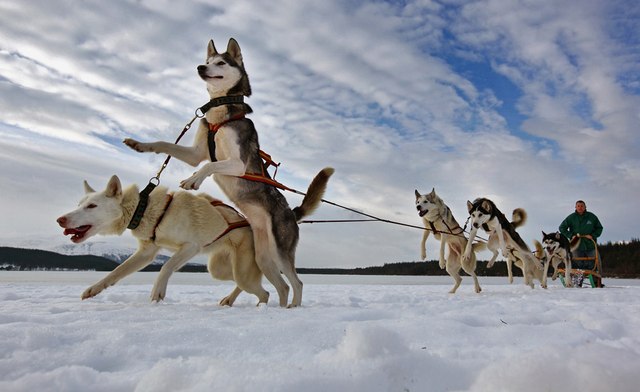
This endurance sport has much of a collectivistic outlook to it as well. The collectivistic outlook comes from the Musher and his team of dogs according to their position in the team relative to the sled. These include leaders or lead dogs, swing dogs, team dogs, and wheelers or wheel dogs. Lead dogs are at the head of the team, listen to the musher, find the trail and set the pace. The swing dogs help with the pace and turn the sled around corners. The team dogs provide the horsepower. The wheel dogs are right in front of the musher and are the strongest dogs on the team. It is a complete team endurance sport. The Musher can of any sex, age, or race, so there is definitely no stereotyping within this endurance sport at all. Cultures of all races can participate in this endurance sport and there is no discrimination between competitors.
Adventure Racing
Adventure Racing (or Expedition Racing) is a sport that combines multiple endurance disciplines into one continuous event. These races can last anywhere from six hours to 10 days. Typically an adventure race will have multiple stages involving Cross-Country Running, Mountain Biking, Paddling, Sailing, or Climbing. Courses are designed so that competitors must navigate their own way between checkpoints. With only a minimal amount of information given to competitors about check point location, land navigation becomes equally as important as technical skill and physical fitness.
The culture of Adventure Racing reflects the sports it is comprised of but has some unique distinctions. There is no typical adventure sport competitor; they come from all walks of life. Though, competitors whose professions predispose them to aspects of adventure racing are common. This includes firefighters, ex-military, and outdoor professionals because of their physical condition and outdoor skills are what is needed in adventure racing. Adventure Racing culture is also very collectivistic, like many team sports. Adventure racing is often done in teams of four. In most races all members of the team must finish together or be disqualified. This creates the need for a leader who can set the tone for the entire team and direction of the race. A good leader is critical to team success. Some races only see 25% of teams completing. Most teams are disqualified do to illness, fatigue, or medical emergencies.
Adventure race culture is very inclusive. Different teams will often help each other out by exchanging spare equipment or navigating together, even though they are technically competing against one another. There are little to no requirements (other than an entrance fee) to register and complete in adventure races. Most endurance sports focus on the individual and allows oneself to separate from the crowd in a constructive way (Walton, 2012). Adventure racing is unique among other endurance sports because of the dual focus on individual and team skill. Overall Adventure Racing exists on a cultural continuum between the two.
Subscribe to:
Posts (Atom)